.svg)
.svg)


.svg)


How Modern Hotel Payment Workflows Shape the Guest Experience
Every hotel strives to create a memorable first impression.
Guests notice the warmth of the welcome, the speed of check-in, and whether the person behind the front desk seems confident and in control. Those first few minutes often set the tone for the entire stay. When everything runs smoothly, the technology supporting that experience remains invisible. Guests simply assume the hotel has everything under control.
The opposite is also true.
A guest who booked and paid through an online travel agency arrives at the hotel only to be asked for another credit card. The front desk agent pauses to search through the reservation, makes a phone call, or asks a colleague for help. What should have been a simple check-in suddenly becomes an uncomfortable conversation, leaving the guest wondering whether something has gone wrong with their reservation.
In most cases, neither the guest nor the employee is responsible for the situation. More often than not, the issue begins long before the guest walks through the front door. Somewhere between the booking platform, the payment provider, the property management system (PMS), and the hotel's internal processes, information didn't move the way it should have.
It's a small operational issue that creates a much bigger guest experience problem.
This is becoming increasingly important as hotels continue expanding the ways guests can pay. Virtual credit cards, digital wallets, Buy Now, Pay Later solutions, and alternative payment methods are quickly becoming part of everyday hotel operations. These options create greater flexibility for guests and open new business opportunities for hotels, but they also introduce additional complexity behind the scenes.
Accepting a payment has never been easier.
Managing everything that happens after that payment is where the real challenge begins.
Payment Is No Longer a Simple Transaction
It's tempting to think of payment as a single event. A reservation is made, a card is charged, and the transaction is complete.
Hotel payment workflows are far more complex than that.
From the moment a reservation enters the PMS until the guest checks out, payment information moves through multiple systems and teams. Charges have to be posted to the correct folio, restaurant purchases need to appear on the guest's final bill, virtual credit cards become available according to specific business rules, and finance teams reconcile every transaction before revenue is recognized.
Each step is relatively straightforward on its own.
Taken together, however, they create a workflow involving reservations, front office operations, food and beverage, accounting, finance, and payment providers. Every department depends on accurate information arriving at the right place at the right time.
The challenge is that this workflow rarely happens within a single technology platform.
Most hotels rely on a collection of specialized systems. The PMS manages reservations and guest stays. Payment gateways authorize transactions. Point-of-sale systems capture restaurant and retail purchases. Finance applications budget and reconcile payments, while additional platforms support reporting, loyalty, and other operational functions.
Each solution does its job well.
The difficulty comes from making all of them work together consistently, especially in a hotel group that has different systems across each category.

Virtual Credit Cards Break the Workflow
Few examples illustrate this better than virtual credit cards.
For many hotels, OTA reservations represent a significant portion of occupancy, and virtual credit cards have become the standard way many of those bookings are paid. They offer security, flexibility, and a reliable method for handling transactions between booking platforms and hotels.
The payment method itself isn't the problem. The operational workflow surrounding it is.
Depending on the PMS and the property's processes, virtual credit card information may be stored in different locations, become available only after specific dates, or simply go unnoticed during a busy shift. In some cases, reservation details are updated throughout the guest journey, making it even harder for employees to know which payment method should be used.
The result is familiar to almost every hotelier.
A guest who has already paid for their reservation is asked for another credit card because the original payment wasn't processed correctly.
From the employee's perspective, they're trying to complete the check-in using the information available on their screen.
From the guest's perspective, the hotel appears unprepared.
Neither side is intentionally creating a poor experience. They're simply experiencing the consequences of disconnected operational workflows.
Hear it from the field
In this short conversation, Jeff Bzdawka, CEO of Hapi, explains why virtual credit card workflows continue to create friction for both hotel teams and guests, and why removing manual processing allows employees to spend more time delivering great hospitality instead of managing payment exceptions.
The Hidden Cost of Manual Payment Workflows
When conversations about hotel payments take place, they often focus on security, fraud prevention, or the growing number of payment options available to guests. Those topics are certainly important, but they overlook a different challenge that affects daily hotel operations just as much: the amount of manual work required to keep payments moving across disconnected systems.
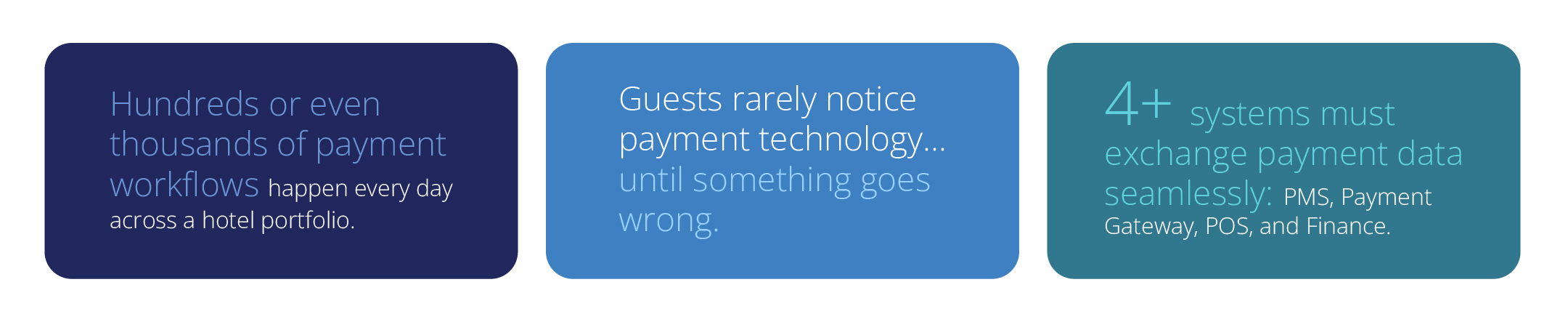
Every reservation creates a chain of operational tasks. Payments need to be authorized, charges posted to the correct folio, transactions reconciled, and exceptions investigated whenever something doesn't happen as expected. None of these activities are particularly difficult in isolation. The problem is that they happen hundreds, or even thousands, of times every day across a hotel portfolio.
When people become responsible for connecting systems that don't automatically share information, even small interruptions begin to accumulate. A front desk agent spends several minutes searching for payment details before completing a check-in. Someone in accounting investigates a transaction that failed unexpectedly. A manager gets involved because a guest questions an additional charge that should never have appeared.
Individually, these moments seem minor.
Collectively, they represent a considerable amount of operational time spent on work that adds little value to either the hotel or the guest.
Perhaps more importantly, manual workflows make consistency difficult. Every property develops slightly different procedures, every employee builds personal habits, and every exception introduces another opportunity for error. These aren't failures caused by people lacking experience or attention to detail. They're the natural outcome of asking employees to bridge the gaps between systems that were never designed to communicate with one another.
Guests Never See the Workflow… Only the Outcome
One of the most interesting aspects of hospitality technology is that guests rarely notice it when it works well.
Nobody leaves a five-star review because payment information moved correctly between the PMS and the payment gateway. Guests don't compliment the hotel because restaurant charges appeared on their folio exactly as expected. These operational successes remain invisible, quietly supporting the experience without drawing attention to themselves.
When something goes wrong, however, the technology suddenly becomes impossible to ignore.
Guests remember waiting at the front desk while employees searched for payment information. They remember being asked for another credit card even though they believed everything had already been paid. They remember calling the hotel after checkout to question an unexpected charge.
These moments shape how people remember their stay, even though the underlying issue has very little to do with hospitality itself.
From the guest's perspective, the payment process is simply part of the overall hotel experience.
They don't distinguish between service problems and operational problems.
To them, it's all the same experience.
Looking Beyond Individual Payment Methods
As payment technology continues to evolve, it's easy to assume that every new payment method introduces a new operational challenge. Digital wallets, Buy Now, Pay Later, account-to-account payments, and virtual credit cards all come with their own rules, timing, and processing requirements. At first glance, it might seem like hotels simply need better tools to support a growing number of payment options.
In reality, that's only part of the story.
Most hotels already have the ability to accept these payment methods. The bigger challenge is making sure every transaction continues its journey correctly after the payment is accepted. Payment information still needs to reach the PMS, appear on the correct folio, flow into accounting systems, and follow property-specific business rules. Every step depends on multiple applications working together, often across technology platforms built by different vendors and introduced years apart.
This is why conversations around hotel payments are beginning to change. Rather than asking, "How do we support another payment method?" many hotel groups are asking a different question: "How do we create payment workflows that remain consistent regardless of how the guest chooses to pay?"
That shift in thinking is important because it moves the conversation away from individual payment methods and toward the operational processes that support the entire guest journey.
Connecting the Workflow
The challenge isn't accepting more payment methods. It's making sure every payment moves through the hotel technology ecosystem accurately and consistently.
That's what Hapi Payment Automations was designed to solve.
Instead of asking hotel teams to act as the connection between payment gateways, PMS platforms, point-of-sale systems, and finance applications, Hapi connects those systems so payment workflows happen automatically across the hotel technology ecosystem. Virtual credit card processing, room charge posting, payment reconciliation, and other operational tasks follow predefined business rules, reducing repetitive manual work while helping hotel teams spend more time focused on guests.
Because at the end of the day, guests don't judge a hotel by how its payment systems work. They judge it by how the experience made them feel.
Ready to Improve Your Payment Workflows?
As payment methods continue to evolve, connected workflows become increasingly important. If your teams are still spending valuable time processing virtual credit cards manually, reconciling transactions across multiple systems, or investigating avoidable payment exceptions, it may be time to rethink the workflow behind your payments.
Hapi Payment Automations connect your PMS, payment gateway, POS, and hospitality applications, helping hotel groups reduce manual work, improve payment accuracy, and create more consistent operations across the portfolio… so your teams can spend more time focused on what matters most: your guests.




Simplify the complex hotel tech landscape
Looking to make the most of your data or better connect systems?






.svg)