


.svg)


.svg)
.svg)


.svg)

.png)
Breaking Down Data Silos in Hospitality: The Case for a Unified Data Layer
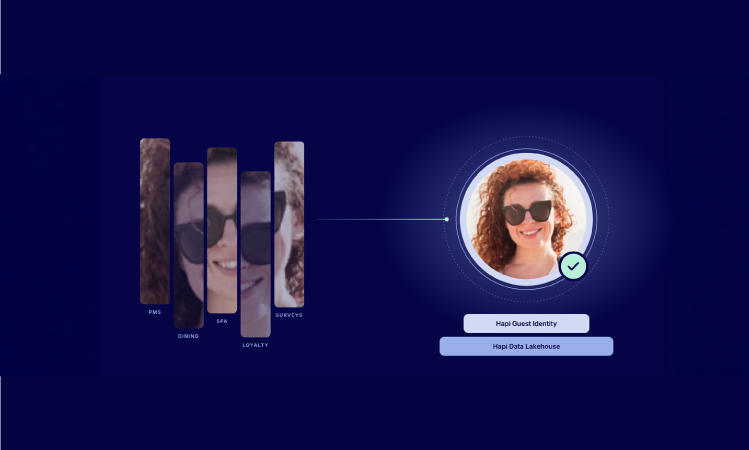
Walk into almost any hotel and you will find a guest who is known by a dozen systems and understood by none. The property management system stores guest profiles, reservations, and folio data. The CRS has its own profile and reservation history. The CRM has their email and marketing preferences, and the loyalty platform has their own data including points and tier data. Each system holds a version of the same person, and none of them are truly in sync. That is the data silo problem, and it is the quiet tax hospitality has been paying for years.
Why hotels drown in their own data
The average hotel runs twenty or more systems. Historically, the only way to make two of them share data was a point-to-point integration: a custom pipe built specifically to move data from System A to System B. Build enough of those and you hit the integration problem every hotel IT team knows by heart. Ten systems that all need to talk to each other can require dozens of one-off connections, each one custom-built, separately maintained, and quietly breaking whenever a vendor pushes an update.
The result is fragmented, stale, and contradictory guest data. The PMS knows the guest's preferred room, but the front desk agent standing in front of them does not. Marketing segments on data that is a week old. Housekeeping misses a preference logged through the app. The hotel is data-rich and insight-poor.
What can be done to fix it
The fix is not another point-to-point pipe. It is an architecture that has become standard in other industries and is finally arriving in hospitality. Three pieces do the work.
A canonical data model is a single, normalized definition of core entities like a guest, a reservation, and an actualized stay. Every source system maps it once, or consumes from a central system. Instead of every system learning to speak to every other system, they all translate into one shared language. The guest who is "GUEST_ID" in one system and "profile_ref" in another becomes one consistent record.
Open APIs make that normalized data accessible. Any authorized application, whether a new guest app, an analytics tool, or an AI assistant, can request the data it needs through a documented, predictable interface rather than a bespoke integration.
Real-time event streaming keeps it current. When a guest checks in, upgrades a room, or settles a tab, that change propagates immediately rather than waiting for an overnight batch. Decisions get made on what is true now, not what was true yesterday.
What it unlocks
Once data lives in a shared, current, accessible layer, the payoffs stack up quickly.
Personalization stops being a slogan. A guest who always books a spa treatment can be greeted with a suggestion for an amenity they have not tried yet, because the relevant history is available at the moment of contact rather than buried three systems away. The bartender finally knows the cocktail.
Operations get faster and cleaner. A guest enters their details once and every system has them, which kills redundant data entry and the errors that come with it. Staff spend less time reconciling records and more time with guests.
Decisions get sharper. When revenue, loyalty, and booking data are consistent and live, revenue managers can price on reality and marketing can segment on behavior rather than guesswork.
And the system can grow. New tools, including the wave of AI-driven guest experiences now arriving, can plug into the data layer through standard APIs instead of demanding yet another custom integration. The hotel that built a unified layer is the hotel that can adopt what comes next without ripping anything out.
Where the industry goes from here
None of this happens overnight, and no hotel should pretend otherwise. A realistic path starts with an honest audit: which systems hold which data, and where are they failing to talk? From there, the priorities are choosing platforms that expose open, well-documented APIs, favoring vendors who commit to industry standards over proprietary lock-in, and building toward a normalized data layer rather than bolting on one more point-to-point connection.
The hotels that get this right will not just run more efficiently. They will be the ones positioned to deliver the personalized, seamless, increasingly AI-assisted experiences guests now expect, because they will be the ones who can actually find their own data when it matters.



Simplify the complex hotel tech landscape
Looking to make the most of your data or better connect systems?
.avif)





.svg)